
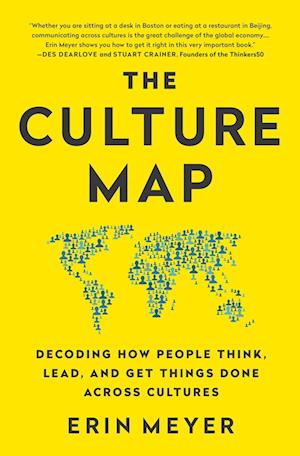
The Culture Map: Breaking Through the Invisible Boundaries of Global Business, by Erin Meyer
Decoding how people think, lead, and get things done across cultures
Review
The Culture Map provides a framework for understanding how cultural differences impact business interactions. Erin Meyer, a professor at INSEAD, presents eight scales that map cultural differences across countries and provides practical guidance for navigating cross-cultural collaboration.
The eight scales covered in the book are:
- Communicating: Low-context vs High-context
- Some cultures communicate explicitly and precisely (low-context, like the US and Germany), while others rely heavily on implicit communication, reading between the lines (high-context, like Japan and Korea).
- Evaluating: Direct negative feedback vs Indirect negative feedback
- How bluntly do people give criticism? Dutch and Germans tend to be direct, while Japanese and Thai cultures wrap negative feedback in positive messages.
- Persuading: Principles-first vs Applications-first
- Some cultures want to understand the "why" before the "how" (France, Italy), while others prefer to start with practical applications and examples (US, Canada).
- Leading: Egalitarian vs Hierarchical
- The distance between boss and subordinate varies greatly. Scandinavian countries are very egalitarian, while Asian cultures tend to be more hierarchical.
- Deciding: Consensual vs Top-down
- In Japan and Sweden, decisions are made by group consensus. In the US and China, decisions can be made quickly by individuals with authority.
- Trusting: Task-based vs Relationship-based
- Some cultures build trust through business activities (US, Germany), while others need personal relationships before doing business (China, Brazil).
- Disagreeing: Confrontational vs Avoids confrontation
- French and Israeli cultures see open debate as positive, while many Asian cultures view open disagreement as disrespectful.
- Scheduling: Linear-time vs Flexible-time
- Germans and Swiss stick rigidly to schedules, while cultures in Africa and the Middle East take a more fluid approach to time.
The Culture Map has been incredibly relevant to my work at Umbraco. Working in a company with colleagues and customers across different countries means constantly navigating these cultural differences. Understanding why a Danish colleague might give direct feedback (while meaning well) or why a customer from Asia prefers to build a relationship before discussing business has been invaluable.
The book helped me realize that what might seem like miscommunication or even rudeness is often just a difference in cultural norms. The frameworks provide a common language for discussing these differences and help prevent misunderstandings before they happen.
I highly recommend The Culture Map to anyone working in international teams or with global customers. Even if you work primarily with people from your own culture, understanding these dimensions helps you appreciate the diversity of approaches to business and leadership.